Fraud allegations and street protests: What’s happening in Armenia after pivotal parliamentary election?

Armenian Prime Minister Nikol Pashinyan and his pro-EU ruling party Civil Contract claimed a decisive victory in the parliamentary elections on June 7 – but the aftermath has been marred by claims of fraud, with a number of parties demanding a recount.
According to the Central Election Commission (CEC), the Civil Contract party captured 49.74% of the vote. The Strong Armenia bloc – founded by Russian-Armenian billionaire Samvel Karapetyan – came in second with 23.27%. Former President Robert Kocharyan’s Armenia Alliance came in third with 9.92%, while Gagik Tsarukyan’s Prosperous Armenia party received only 3.98%, narrowly missing the 4% parliamentary threshold.
The election was widely seen as a referendum on Armenia’s future geopolitical path. All three opposition parties are Euroskeptic and advocate closer ties with Russia, which remains a key trade partner and dominant energy supplier, providing natural gas at heavily discounted prices. Pashinyan’s party has pushed for closer ties with the EU while seeking to take advantage of the economic benefits of Armenia’s close ties with Russia.

Moscow has said it took note of the reports of irregularities and has so far refrained from congratulating Pashinyan. It has also sounded the alarm over the “unprecedented pressure on the opposition and interference from the West.”
Here is what is going on in Armenia after the election.
Were there invalid votes?
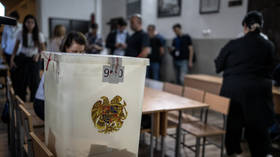
The Central Election Commission (CEC) annulled the results at three polling stations – station 10/51 in Yerevan’s Nubarashen district, and station 35/65 in Agarak, in the southern Syunik region – after reports of large numbers of military personnel arriving at both sites after the polls officially closed at 8:00 PM and continuing to vote for hours. According to local media reports, around 480 service members were allowed to vote in violation of the regulations.

Later, the CEC annulled the results at a third precinct – 12/13 – after it emerged that ballot papers for one party were missing throughout the day.
However, it refused to hold recounts at three other stations, citing the dangers of “tactical voting” – triggering accusations from the opposition that the decision was illegal.
Is the opposition demanding a recount?
Strong Armenia has demanded the annulment of the results, alleging that Civil Contract improperly amassed around 100,000 votes using administrative resources, including directing public-sector employees and military personnel to vote for the ruling party.
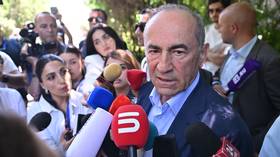
Samvel Karapetyan acknowledged that while his party “did not win, neither did Pashinyan,” adding that Armenia “has no legitimate authority” as the election was “completely... falsified.” He vowed to take the fight to the parliament, or even to the streets.
Another drama unfolded around Prosperous Armenia, which was teetering on the parliamentary threshold and could have been most affected by the recount. Before the announcement of the final results, it argued that the CEC’s decision to annul the results in several polling stations cost it 213 votes, which it said would have pushed it over the top.

In total, the opposition demanded recounts at 555 out of 2,005 polling stations. The CEC later published the results of a partial recount for 637 polling stations, adding 1,148 votes to Civil Contract, 508 to Strong Armenia, and 147 to Prosperous Armenia, though not enough for Prosperous Armenia to make it to parliament.
Was there a crackdown on Armenian opposition figures?
The crackdown on the opposition began well before election day, with Samvel Karapetyan under arrest since last year on charges of inciting a coup d’etat, which he denies. On June 6 – the day before the election – six candidates from Strong Armenia were arrested on charges of vote-buying and money laundering.
According to Karapetyan, 75 supporters of Strong Armenia were arrested during the election, with more than 700 detained. Kocharyan’s party said around a dozen of its activists in the country’s second-largest city of Gyumri were rounded up after searches were conducted in their homes.
In the days after the election, the authorities said they had brought criminal charges against 242 people. Armenia’s anticorruption committee said 115 charges were related to graft-related cases, with the bulk accounting for the members of the Strong Armenia bloc.
In addition, Kocharyan’s office said on Sunday that the former president was banned from leaving the country, with officials providing no explanation.
Is the opposition protesting?
Prosperous Armenia has been the most vocal regarding protests. Prominent member Suren Surenyanc warned that if “Pashinyan does not stop… the lawlessness, all government buildings and streets of Yerevan will be flooded with tens of thousands of people.”

Karapetyan has not ruled out protests, but said he would first try to dispute the results by other means, insisting that his party’s main goal is to remove Pashinyan from power.
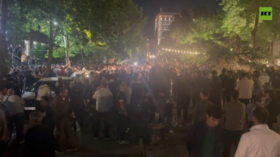
On Sunday, as the CEC was certifying the votes, hundreds of protesters rallied outside the building, demanding the annulment of the results. The protest was peaceful, with a heavy police presence on site.
What does Russia say about Armenia’s elections?
Russia has raised concerns over transparency. Kremlin spokesman Dmitry Peskov said Russia is “taking note of reports regarding numerous violations,” and has held off on congratulating Pashinyan before the final results are announced.

Russian Foreign Ministry spokeswoman Maria Zakharova said the elections took place “amid unprecedented pressure on the opposition and interference from the West, primarily the EU,” and that Civil Contract failed to obtain a “monopoly on power.” She argued that support for Pashinyan has “noticeably declined” since the previous election.

Zakharova added that Moscow is interested in Armenia remaining a strong and sovereign country, but warned that its reluctance to take heed of public sentiment risks “leading the country toward further division and socioeconomic upheaval.”
What does the West say?
The Organization for Security and Cooperation in Europe (OSCE) described the election as “a well-run process,” but acknowledged that the campaign was “highly confrontational, with divisive rhetoric” and marked by “allegations of vote-buying and other electoral violations that led to numerous criminal proceedings against opposition candidates and activists.”
Without waiting for the final results and recount, European Council President Antonio Costa congratulated Pashinyan and declared that Armenians voted for “peace, stability and stronger cooperation.” European Commission President Ursula von der Leyen said Armenia can count on the EU.
Several days before the election, Brussels pledged more than €50 million in emergency financial assistance to Armenia, which it said was meant to ease trade for Armenian agricultural products hit by recent Russian sanctions – a move that Moscow said was not political but linked to safety concerns sparked by seasonal harvest inspections.